
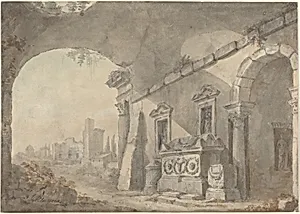
Roman Ruins with a Sepulchre
1701 to 1725
Medium
pen and gray ink with watercolor on laid paper
Dimensions
overall: 26.2 x 36.9 cm (10 5/16 x 14 1/2 in.)
Classification
Drawing
Department
CG-E
Museum
National Gallery of Art, Washington, D.C.
Credit
Gift of William B. O'Neal, in Honor of the 50th Anniversary of the National Gallery of Art
Accession Number
1991.150.13
Rights
Public Domain
Art Historical Context
Charles Louis Clérisseau’s “Roman Ruins with a Sepulchre” captures the enduring fascination with classical antiquity that swept through eighteenth-century Europe. Created between 1701 and 1725, the drawing presents crumbling arches, weathered stone, and a quiet sepulchre that evoke the grandeur and melancholy of ancient Rome. Such scenes were not mere records of the past but meditations on time, memory, and the enduring power of architecture. Executed in pen and gray ink with delicate watercolor washes on laid paper, the work demonstrates Clérisseau’s mastery of precise line and subtle tonal effects. The medium allowed him to convey both the crisp geometry of ruined vaults and the soft play of light across weathered surfaces. Measuring just over ten by fourteen inches, the drawing rewards close viewing, revealing the artist’s skill in balancing architectural accuracy with poetic atmosphere. Now part of the National Gallery of Art’s collection through a generous gift honoring the museum’s fiftieth anniversary, this sheet reflects the period’s growing interest in archaeological study and neoclassical ideals. It continues to invite viewers to contemplate how ruins speak across centuries.