
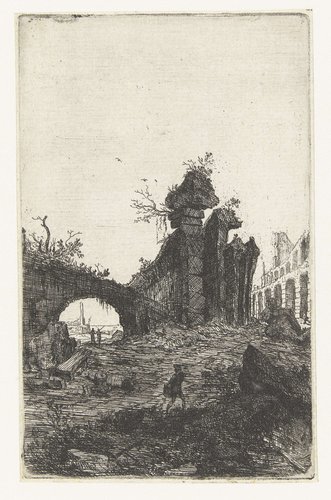
Romeinse ruïnes
1639 - 1640
Medium
etching
Dimensions
104; 64
Rights
Public Domain
About this artwork
plaatrand: hoogte 104 mm x breedte 64 mm
Art Historical Context
Bartholomeus Breen's *Romeinse ruïnes* (Roman Ruins), created around 1639-1640, captures the artist's fascination with classical antiquity during the Dutch Golden Age. Breenbergh, a Dutch painter and etcher who spent a decade in Rome (1619-1629), drew inspiration from the Eternal City's weathered monuments. This intimate etching reflects the 17th-century Northern European vogue for Italianate landscapes, blending precise observation of ancient architecture with a sense of nostalgic grandeur. Etched on a modest plate measuring 104 mm high by 64 mm wide, the work exemplifies Breenbergh's mastery of printmaking. Etching, using acid to bite lines into a metal plate, allowed for delicate, intricate details—perfect for evoking the textures of crumbling stone and overgrown foliage in such a compact format. These small prints were highly collectible, enabling artists like Breenbergh to reach wider audiences beyond oil paintings. As a window into 17th-century cultural reverence for Rome's past, *Romeinse ruïnes* highlights how Dutch artists romanticized ruins as symbols of time's passage and human achievement. Breenbergh's precise lines and atmospheric depth make this piece a gem for admirers of classical revival in Northern art.
About the Artist
Bartholomeus Breenbergh · 1598–1657
Probably was apprenticed in Amsterdam. He was one of the early Dutch italianates, that is, northern artists who travelled to Italy in the 1620s and were inspired by southern landscapes. On his return, he settled in Amsterdam and his landscapes were developed as more severe and monumental, often with historical subjects; strongly influenced by the Pre-Rembrandtists. Comment on works: Landscapes; Ru...