
Romeinse ruiter te paard
1567
Medium
engraving
Dimensions
33; 29
Rights
Public Domain
About this artwork
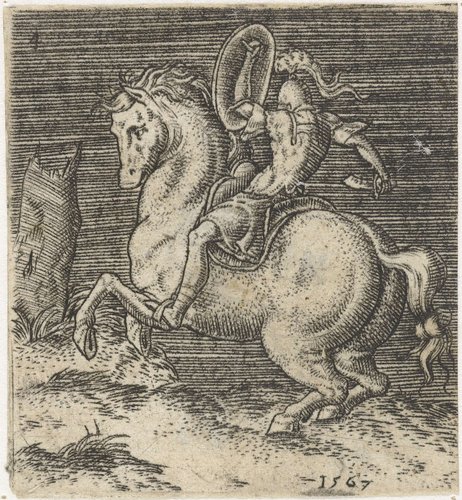
Een Romeins soldaat te paard, rijdend naar links. Het paard steigert.
Art Historical Context
Abraham de Bruyn's *Romeinse ruiter paard* (Roman Rider Horseback), created in 1567, is a exquisite small-scale engraving measuring just 29mm wide by 33mm high. This intricate print captures a Roman soldier charging to the left astride a rearing horse, evoking the drama and power of ancient cavalry in battle. The dynamic pose, with the horse's front legs kicking high, showcases de Bruyn's skill in rendering motion and anatomy within a tiny format. As a prominent Flemish engraver of the Renaissance, de Bruyn specialized in detailed costume books and historical scenes, drawing from classical antiquity to fuel the era's fascination with Rome. Engraving allowed for precise lines and mass production, making such vivid depictions accessible beyond elite patrons—likely part of a series on military attire for collectors and scholars. This technique's fine burin work highlights the horse's musculature and the rider's armor, blending historical accuracy with artistic flair. Culturally, the print reflects 16th-century Europe's revival of Roman imagery amid wars and humanism, inspiring military fashion and art. Its miniature size invites close inspection, revealing a world of ancient valor in your palm—a testament to engraving's role in preserving history for everyday wonder.