
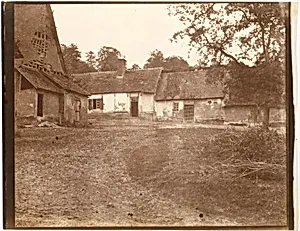
Romesnil
1850–55
Medium
Salted paper print from paper negative
Dimensions
27 x 35.2 cm (10 5/8 x 13 7/8 in.)
Classification
Photographs
Department
Photographs
Museum
Metropolitan Museum of Art, New York, NY
Credit
Purchase, Joseph Pulitzer Bequest, 1996
Accession Number
1996.363.2
Rights
Public Domain
Tags
Art Historical Context
Welcome to the Metropolitan Museum of Art's photography collection, where Louis-Rémy Robert's *Romesnil* (1850–55) captures humble charm of rural French architecture. This salted paper print from a paper negative depicts sturdy barns in the Normandy village of Romesnil rendered with a soft, atmospheric glow typical of early photographic processes. At 27 x 35.2 cm, its intimate scale invites viewers to linger on the textured stone walls and weathered roofs, evoking the everyday poetry of 19th-century countryside life. Created during photography's pioneering decade, the work showcases the calotype technique—invented by William Henry Fox Talbot—which used paper negatives to produce multiple prints with subtle tonal gradations. Robert, a French photographer trained under Hippolyte Bayard and Gustave Le Gray, embraced this method for its artistic potential, bridging painting's impressionistic qualities with mechanical precision. Unlike the sharp detail of daguerreotypes, salted paper prints like this one offered a painterly softness, making them ideal for architectural studies that celebrated light and shadow. Acquired through the Joseph Pulitzer Bequest in 1996, *Romesnil* highlights photography's role in documenting vanishing rural traditions amid France's industrializing landscape. It's a quiet testament to how early photographers transformed barns—symbols of agrarian endurance—into enduring visual legacies.