
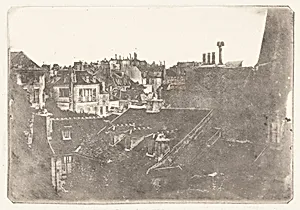
Rooftops
c. 1840
Medium
photogravure
Dimensions
image: 6.9 × 9.3 cm (2 11/16 × 3 11/16 in.) sheet: 14.1 × 17.6 cm (5 9/16 × 6 15/16 in.)
Classification
Photograph
Department
CPH
Museum
National Gallery of Art, Washington, D.C.
Credit
Alfred H. Moses and Fern M. Schad Fund
Accession Number
2023.33.3
Rights
Public Domain
Art Historical Context
Created around 1840 by French physicist and pioneering photographer Hippolyte Louis Fizeau, *Rooftops* stands as an early and remarkable example of photogravure. This intaglio printing process, which Fizeau helped refine, allowed photographic images to be etched onto metal plates and reproduced on paper with remarkable tonal subtlety. The modest scale of the image—just under 7 by 9 centimeters—belies its technical ambition, capturing a quiet urban vista that evokes the intimate, experimental spirit of photography’s first decade. At a moment when Louis Daguerre’s process was still new and Talbot was developing the calotype, Fizeau’s photogravure offered a bridge between the one-of-a-kind photograph and the reproducible print. The work’s modest sheet size and crisp architectural details reflect both the limitations and the poetic possibilities of the medium: light-sensitive chemistry meeting traditional printmaking craft. Today, *Rooftops* reminds viewers how quickly the new technology of photography began reshaping how the world could be seen and shared.