
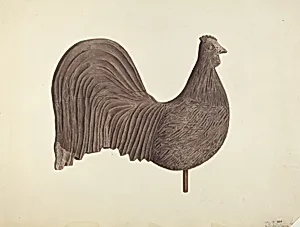
Rooster Weather Vane
probably 1940
Medium
watercolor, graphite, and colored pencil on paper
Dimensions
overall: 38.3 x 53.2 cm (15 1/16 x 20 15/16 in.)
Classification
Index of American Design
Department
CG-W
Museum
National Gallery of Art, Washington, D.C.
Credit
Index of American Design
Accession Number
1943.8.8060
Rights
Public Domain
Art Historical Context
**Rooster Weather V** *Michael Riccitelli, probably1940* Watercolor, graphite, and pencil on paper, 38.3 x 53.2 cm (15 1/16 x 20 15/16 in.) *Index of American Design, National Gallery of Art* into the vibrant world of American folk art with Michael Riccitelli's captivating rendering of a classic rooster weather vane. Created around 1940 as part of the Federal Art Project's Index of American—a WPA initiative during the Great Depression—this watercolor, graphite, and colored pencil work meticulously documents a quintessential piece of everyday Americana. Riccitelli's precise technique captures the rooster's bold silhouette, dynamic pose, and weathered patina, blending realism with artistic flair to preserve vanishing cultural artifacts. Rooster weather vanes, perched atop barns and steeples since colonial times, symbolize vigilance and good fortune, their swirling forms pointing the way for farmers and sailors alike. The Index of American Design employed over 200 artists like Riccitelli to create more than 15,000 such detailed studies, safeguarding the ingenuity of American craftsmanship amid economic hardship. This piece highlights the medium's strength: watercolor's luminous transparency evokes the metal's shine, while graphite and colored pencil add fine lines and subtle hues for lifelike accuracy. Today, it invites us to appreciate how ordinary objects embody our shared history, reminding visitors of the enduring spirit of American design.
About the Artist
Michael Riccitelli · 1855–present
**Michael Riccitelli** (American, active c. 1935) was a skilled draftsman whose precise watercolor renderings captured the essence of American folk art during the Great Depression era. Little is known about his early life or formal training, as biographical details remain scarce. He gained prominence through his contributions to the Index of American Design (IAD), a Works Progress Administration (...