
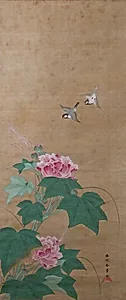
Rose Mallow (Fuyō)
18th century
Medium
Hanging scroll; ink and color on silk
Dimensions
28 1/2 x 12 1/8 in. (72.4 x 30.8 cm)
Classification
Paintings
Culture & Period
Japan · Edo period (1615–1868)
Department
Asian Art
Museum
Metropolitan Museum of Art, New York, NY
Credit
Charles Stewart Smith Collection, Gift of Mrs. Charles Stewart Smith, Charles Stewart Smith Jr., and Howard Caswell Smith, in memory of Charles Stewart Smith, 1914
Accession Number
14.76.38
Rights
Public Domain
Tags
Art Historical Context
**Rose Mallow (Fuyō)** by Katsukawa Shunshō the delicate beauty of nature in an exquisite 18th-century hanging, rendered in ink and color on silk. Measuring 28½ x 12⅛ inches, this Edo-period (1615–1868) work from Japan's vibrant artistic scene depicts the rose mallow flower—known as *fuyō*—alongside birds, evoking the harmonious interplay of flora and fauna that was a beloved motif in Japanese painting. Shunshō, a leading in the Katsukawa school of ukiyo-e ("pictures of the floating world"), masterfully blends precise ink lines with soft color washes, bringing the petals' subtle shifts from white to pink and the birds' lively presence to vivid life. Hanging scrolls like this were prized possessions in Edo-era homes, unrolled for seasonal display or contemplation, reflecting the period's prosperity and appreciation for refined aesthetics amid urban kabuki culture. Shunshō's technique highlights his versatility beyond actor portraits, showcasing *kachō-e* (flower-and-bird pictures) traditions that symbolized transience and natural elegance. Part of the Metropolitan Museum of Art's Asian Art collection, gifted in 1914 from the Charles Stewart Smith family, it invites visitors to ponder Japan's enduring reverence for nature's fleeting grace.
About the Artist
Katsukawa Shunshō 勝川春章 (Japanese) · 1726 –1792
Japanese, 1726–1792