
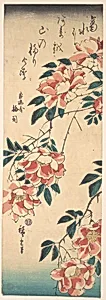
Roses
ca. 1843
Medium
Woodblock print; ink and color on paper
Dimensions
13 1/4 x 4 15/32 in. (33.7 x 11.4 cm)
Classification
Prints
Culture & Period
Japan · Edo period (1615–1868)
Department
Asian Art
Museum
Metropolitan Museum of Art, New York, NY
Credit
Purchase, Joseph Pulitzer Bequest, 1918
Accession Number
JP266
Rights
Public Domain
Tags
Art Historical Context
Utagawa Hiroshige1797–1858), one of Japan's most celebrated ukiyo-e masters created *Roses* around 1843 during the Edo period (1615–1868). This woodblock print exemplifies "pictures of the floating world", which captured fleeting beauty in everyday life, nature, and seasons. Hiroshige, famed for his evocative landscapes like *The Fifty-three Stations of Tōkaidō*, also excelled in intimate floral studies, rendering roses with delicate precision amid lush leaves—a nod to Japan's profound appreciation for nature's transience, akin to ikebana flower arranging. Printed with ink and vibrant colors on paper, the work measures a slender 13¼ × 4⅞ inches, typical of ukiyo-e's narrow ōban format designed for affordable albums and fans. Hiroshige's technique shines in his subtle gradations of color (bokashi) and dynamic compositions, where overlapping petals and veined leaves create depth and vitality on the flat picture plane. Produced via collaborative woodblock carving—artists designed, carvers sculpted, printers inked—this method democratized art for urban Edoites. Housed in the Metropolitan Museum of Art's Asian Art Department since 1918, *Roses* highlights ukiyo-e's global influence on Impressionists like Monet. Its simple subject belies Hiroshige's genius in evoking quiet elegance, inviting viewers to savor nature's quiet poetry.
About the Artist
Utagawa Hiroshige · 1826–1869
Utagawa Hiroshige (1797–1858), born Andō Tokutarō, was the last great master of Japanese ukiyo-e woodblock printmaking and one of the most influential landscape artists in history. Born in Edo (modern Tokyo) into a low-ranking samurai family serving as fire wardens, Hiroshige transformed landscape printmaking into a poetic meditation on nature, weather, and everyday life. His revolutionary approac...