
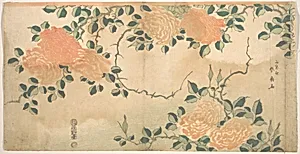
Roses
ca. 1810
Medium
Woodblock print; ink and color on paper
Dimensions
H. 7 13/16 in. (19.8 cm); W. 15 3/16 in. (38.6 cm)
Classification
Prints
Culture & Period
Japan · Edo period (1615–1868)
Department
Asian Art
Museum
Metropolitan Museum of Art, New York, NY
Credit
Rogers Fund, 1926
Accession Number
JP1486
Rights
Public Domain
Tags
Art Historical Context
Behold the delicate beauty of *Roses* by Kashōsai Shunsen, a woodblock print from around 1810, now housed in the Metropolitan Museum of Art's Asian Art Department. This intimate work, measuring just under 8 by 15 inches, showcases lush roses and their accompanying leaves rendered in vibrant inks and colors on paper.unsen, a skilled Japanese artist of the Edo period (1615–1868), was renowned for his contributions to ukiyo-e—the "pictures of the floating world"—a popular genre celebrating ephemeral pleasures like nature's fleeting blooms. Woodblock printing, the medium's hallmark, involved a meticulous collaborative process: the artist designed the image, carvers sculpted the blocks, and printers applied pigments layer by layer for stunning depth and nuance. During the Edo era, such prints democratized art, making sophisticated depictions of flowers accessible beyond elite circles. Roses, though not native to Japan, symbolized elegance and transience in this context, echoing broader themes of impermanence in Japanese aesthetics like *mono no aware*. This Rogers Fund acquisition of 1926 exemplifies the refined naturalism of late Edo ukiyo-e, inviting visitors to savor the petals' lifelike texture and subtle color gradients—a timeless tribute to nature's quiet splendor.