
Rosette Brooch
Unknown Artist
500–700
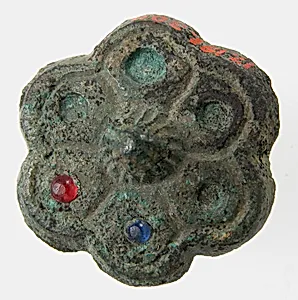
Medium
Copper alloy, glass cabochon, iron pin
Dimensions
Overall: 7/8 x 9/16 in. (2.2 x 1.4 cm)
Classification
Metalwork-Copper alloy
Culture
Frankish
Department
Medieval Art
Museum
Metropolitan Museum of Art, New York, NY
Credit
Gift of J. Pierpont Morgan, 1917
Accession Number
17.191.300
Rights
Public Domain
Art Historical Context
Nestled in the Metropolitan Museum of Art's Medieval collection, this delicate Rosette Brooch exemplifies Frankish metalwork from the early Middle Ages, dating to 500–700 CE.ed from copper alloy with a vibrant glass cabochon at its center and an iron pin fastening, it measures just 7/ x 9/16 inches—perfect for personal adornment on cloaks or tunics. The rosette design, evoking a blooming flower, reflects the intricate motifs popular among the Franks, a Germanic people who dominated much of western Europe after the fall of Rome. Frankish jewelry like this brooch was more than decorative; it signaled status and craftsmanship in a turbulent era of migration and kingdom-building. The use of copper alloy made it accessible beyond elite gold pieces, while the imported glass cabochon hints at trade networks spanning the Mediterranean. Techniques such as casting and inlay demonstrate skilled artisanship, blending utility with subtle elegance. A generous gift from J. Pierpont Morgan in 1917, this tiny treasure offers a window into daily life during the Merovingian period, reminding us how even small objects preserved cultural identity amid change.