
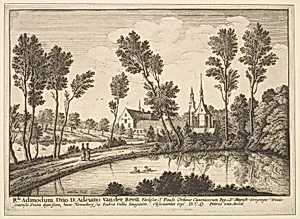
Rothendael Abbey
Medium
Etching, second state of three
Dimensions
Sheet: 6 1/8 × 8 1/2 in. (15.6 × 21.6 cm)
Classification
Prints
Department
Drawings and Prints
Museum
Metropolitan Museum of Art, New York, NY
Credit
Harris Brisbane Dick Fund, 1917
Accession Number
17.3.1166-644
Rights
Public Domain
Tags
Art Historical Context
Created in 1648, *Rothendael Abbey* a delicate etching by Wenceslaus Hollar after a design by Flemish artist Pieter van Avont. Hollar, Bohemian-born printmaker renowned his precise topographical views, worked extensively in Antwerp during this period. The work captures a tranquil monastic landscape featuring the abbey church reflected in a pond, with ducks gliding across the water. As a second-state impression of three, the print reveals the careful evolution of the copperplate as the artists refined details of light, texture, and reflection. Etching allowed Hollar to achieve remarkable subtlety in line and tone, making the medium ideal for conveying both architectural grandeur and the quiet rhythms of nature. Produced in the final year of the Thirty Years’ War, the image offers a peaceful counterpoint to the era’s turmoil, inviting viewers to contemplate the enduring harmony between human-made structures and the natural world. Today housed in the Metropolitan Museum of Art, this modest sheet exemplifies the seventeenth-century print’s power to preserve and share moments of serene beauty across centuries.
About the Artist
Wenceslaus Hollar|Pieter van Avont · 1607–1677
Wenceslaus Hollar (1607-1677) was a prolific Bohemian etcher who became one of the most accomplished printmakers of the seventeenth century. Born in Prague, he trained under Matthäus Merian in Frankfurt before entering the service of Thomas Howard, Earl of Arundel, in 1636. Hollar spent most of his career in England, where he produced approximately 2,740 etchings documenting an extraordinary range...