
Rotherhithe
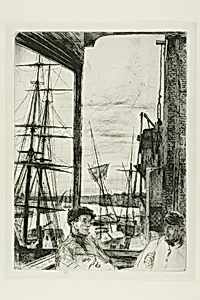
Medium
Etching and drypoint with foul biting in black ink on ivory laid paper
Dimensions
Plate: 27.5 × 20 cm (10 7/8 × 7 7/8 in.); Sheet: 29.6 × 22.2 cm (11 11/16 × 8 3/4 in.)
Classification
etching
Department
Prints and Drawings
Museum
Art Institute of Chicago
Accession Number
73653
Rights
Public Domain
Art Historical Context
James McNeill Whistler's *Rotherhithe* (1860) captures the gritty allure of London's Thames waterfront in the mid-19th century, a time when the river bustled with trade ships and working-class life. Part of Whistler's celebrated "Thames Set" of etchings, this depicts the dockside at Rotherhithe, ev the smoky, industrial atmosphere of Victorian England. Whistler, an American expatriate in London, drew inspiration from realist artists like Gustave Courbet and Japanese prints, pioneering a tonal, atmospheric style that prioritized mood over narrative detail—foreshadowing his later Aesthetic movement ideals of "art for art's sake." Printed in black ink on ivory laid paper using etching, drypoint, and subtle foul biting (accidental acid corrosion adding rich texture), the work exemplifies Whistler's innovative printmaking. Etching allowed precise lines incised into a copper plate, while drypoint's direct scratches created velvety burrs for depth and softness. At 27.5 × 20 cm (plate size), its intimate scale invites close viewing, revealing intricate details of figures, masts, and rippling water. Housed in the Art Institute of Chicago's Prints and Drawings Department, *Rotherhithe* highlights Whistler's mastery in transforming everyday scenes into poetic harmonies, influencing modern printmakers and celebrating the Thames as a timeless muse.
About the Artist
James McNeill Whistler · 1834–1903
James Abbott McNeill Whistler (1834-1903) was an American-born painter and printmaker who became a leading figure in the Aesthetic Movement and pioneer of Tonalism and Japonisme. He revolutionized art by championing "art for art's sake" and treating paintings as visual equivalents of musical compositions, titling works as "arrangements," "harmonies," and "nocturnes" to emphasize formal qualities o...