
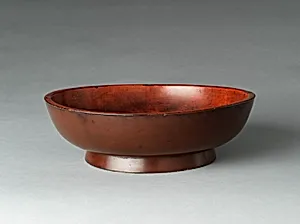
Round bowl
Unknown Artist
dated 1580
Medium
Red and black lacquer; Negoro ware
Dimensions
Diam.12 7/8 in. (32.6 cm)
Classification
Lacquer
Culture & Period
Japan · Momoyama period (1573–1615)
Department
Asian Art
Museum
Metropolitan Museum of Art, New York, NY
Credit
Gift of Florence and Herbert Irving, 2020
Accession Number
2020.323.5
Rights
Public Domain
Art Historical Context
This elegant round bowl, crafted in 1580 during Japan's vibrant Momoyama period (1573–1615), exemplifies the artistry of Negoro ware, a revered lacquer tradition from the Neg-ji temple in Wakayama Prefecture. Measuring 12⅞ inches in diameter, it features striking red and black lacquer on a wooden base. Negoro ware's signature technique involves layering black ur lacquer first, followed by a red outer coat. Over time, use naturally wears the red layer, revealing the underlying black and creating a beautifully patinated, aged appearance that Japanese connoisseurs prized for its wabi-sabi aesthetic—celebrating imperfection and transience. In the Momoyama era, marked by warring feudal lords and cultural flourishing, lacquerware like this bowl held deep significance. Often used in tea ceremonies or temple rituals, it reflected the period's bold, opulent tastes amid the rise of chanoyu (the tea ceremony). The unknown artist's mastery of lacquer—derived from the sap of the urushi tree—demonstrates technical prowess: multiple thin layers applied over months, polished to a glossy sheen resilient to heat, moisture, and wear. Today, this gift from Florence and Herbert Irving at The Metropolitan Museum of Art invites us to appreciate how everyday objects embodied Zen philosophy and samurai refinement, bridging utility and profound beauty.