
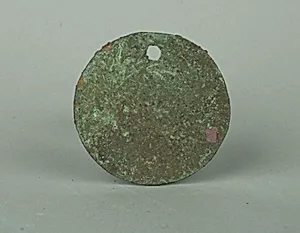
Round Plaque
Unknown Artist
3rd century BCE–2nd century CE
Medium
Copper (hammered), gilt
Dimensions
Diameter 1-7/16 in. (3.7 cm)
Classification
Metal-Ornaments
Culture
Vicús
Department
Arts of Africa, Oceania, and the Americas
Museum
Metropolitan Museum of Art, New York, NY
Credit
Bequest of Jane Costello Goldberg, from the Collection of Arnold I. Goldberg, 1986
Accession Number
1987.394.499
Rights
Public Domain
Art Historical Context
This exquisite *Round Plaque* from Vicús culture of ancient Peru (3rd century BCE–2 century CE) is a to the mastery of pre-Columbian metalworkers on the northern coast. Crafted from hammered copper and adorned with gilding—a technique that applied a thin layer of gold to mimic the luster of solid gold—this small ornament (just 1-7/16 inches in) likely served as jewelry, a ceremonial badge, or a decorative element on textiles or garments. Its intimate scale invites close admiration, revealing the precision of Vicús artisans who transformed humble copper into objects of prestige. The Vicús people, flourishing in the Piura region from around 1000 BCE to 200 CE, were renowned for their innovative metallurgy, bridging earlier Mochica influences with later cultures like the Moche. Hammering the thin copper sheet allowed for intricate repoussé designs—raised motifs hammered from the reverse—often depicting mythical felines, warriors, or geometric patterns symbolizing power and cosmology. Though the exact imagery on this plaque remains a mystery without further detail, it embodies Vicús emphasis on portability and shine, reflecting elite status in a society where metals signified divine favor. Housed in the Metropolitan Museum of Art's Department of the Arts of Africa, Oceania, and the Americas, this piece—bequeathed by Jane Costello Goldberg in 1986—offers a window into Andean ingenuity long before the Inca. Visitors are drawn to its delicate glow, a reminder of how ancient Peruvians turned earth's metals into enduring art.