
Round Stool
1936
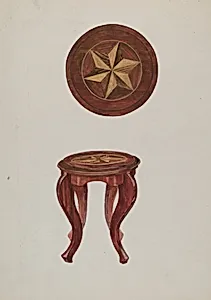
Medium
watercolor, colored pencil, and graphite on paper
Dimensions
overall: 35.5 x 24.4 cm (14 x 9 5/8 in.) Original IAD Object: 16 1/2" x 14"wide
Classification
Index of American Design
Department
CG-W
Museum
National Gallery of Art, Washington, D.C.
Credit
Index of American Design
Accession Number
1943.8.5541
Rights
Public Domain
Art Historical Context
**Round Stool**, a meticulous 1936 rendering by Verna Tallman, the simple elegance of an everyday American furniture piece as part of the Index of American Design (IAD). Created during the Great Depression, the IAD was a Works Progress Administration (WPA initiative that employed artists to document the nation's folk art, crafts, and design heritage through detailed watercolor studies. Tallman's work preserves the cultural essence of vernacular objects like this round stool, highlighting their role in American domestic life and craftsmanship traditions. Executed in watercolor, colored pencil, and graphite on paper (35.5 x 24.4 cm), the piece showcases the IAD's signature technique: precise, lifelike depictions that emphasize texture, form, and subtle color variations. These media allowed artists to convey the stool's sturdy construction and humble materiality with scientific accuracy, making it both an artistic achievement and a historical record. Housed in the National Gallery of Art, it reflects the era's commitment to celebrating ordinary ingenuity amid economic hardship. Today, **Round Stool** invites visitors to appreciate how such designs embodied practicality and regional pride, bridging art, history, and everyday American identity.
About the Artist
Verna Tallman · 1855–present
Verna Tallman remains a figure about whom the historical record has preserved very little. No birth or death dates have been established, and her nationality and training are not documented in major reference sources. The works attributed to her suggest an engagement with decorative or illustrative traditions, though without more contextual documentation it is difficult to place her within a spec...