
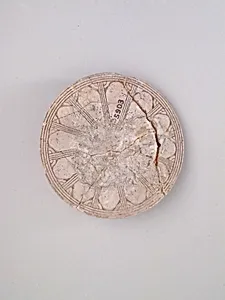
Roundel, disk
Unknown Artist
13th–12th century BCE
Medium
Hippopotamus ivory
Dimensions
Diameter: 2 1/2 x 1/4 in. (6.4 x 0.7 cm)
Classification
Miscellaneous-Bone, Ivory
Culture
Cypriot
Department
Greek and Roman Art
Museum
Metropolitan Museum of Art, New York, NY
Credit
The Cesnola Collection, Purchased by subscription, 1874–76
Accession Number
74.51.5213
Rights
Public Domain
Art Historical Context
This delicate roundel, or disk, crafted from hippopotamus ivory, hails from ancient Cyprus during the Late Bronze Age (13th–12th century BCE). Measuring just 2½ inches in diameter and a mere quarter-inch thick, its petite scale suggests it served as an inlay for furniture, a decorative ornament, or perhaps part of a larger composite object like jewelry or a seal. The use of hippopotamus ivory—a rare material sourced from Nile River hippos in Egypt—highlights Cyprus's pivotal role as a bustling trade nexus in the eastern Mediterranean, linking the Aegean, Levant, and Near East. Ivory-working was a prized craft in Cypriot culture, symbolizing wealth and technical mastery. Artisans likely carved and polished this disk by hand, exploiting the material's creamy translucence and durability to create subtle luster. Such objects reflect the island's cosmopolitan society, influenced by Mycenaean Greeks, Egyptians, and locals, during a time of vibrant exchange before the Bronze Age collapse. Acquired through The Cesnola Collection—assembled by diplomat-turned-archaeologist Luigi Palma di Cesnola in the 1870s—this piece now graces the Metropolitan Museum of Art's Greek and Roman Art department, offering a tangible glimpse into Cyprus's enigmatic ancient world.