
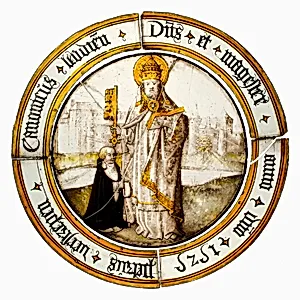
Roundel with Saint Peter as Pope
Unknown Artist
ca. 1525
Medium
Colorless glass, silver stain, vitreous paint
Dimensions
13 × 1/4 in. (33 × 0.6 cm) figurative area only: 8 3/4 × 1/8 in. (22.2 × 0.3 cm)
Classification
Glass-Stained
Culture
South Netherlandish
Department
The Cloisters
Museum
Metropolitan Museum of Art, New York, NY
Credit
The Cloisters Collection, 1932
Accession Number
32.24.62
Rights
Public Domain
Tags
Art Historical Context
This delicate stained glass roundel, created by an unknown South Netherland artist around 1525, depicts Saint enthroned as the first, symbolized by the keys of heavenly authority clutched in his hands. Roundels like this were small, circular panels popular in the Renaissance Low Countries, often adorning private homes, chapels, or secular buildings rather than grand cathedrals. Housed in The Cloisters Collection at The Metropolitan Museum of Art since1932, it exemplifies the refined glasswork of the region during a period of religious fervor and artistic innovation. Crafted from thin sheets of colorless glass—measuring just a quarter-inch thick—the artwork employs silver stain for golden highlights and vitreous paint for fine details, techniques that revolutionized Northern European stained glass. Silver stain, fired onto the glass, created durable yellow tones without layering colored glass, allowing artists to achieve painterly effects like Peter's papal tiara and flowing robes. This method marked a shift toward more naturalistic figures, blending Gothic traditions with emerging Renaissance realism. As a devotional image, the roundel underscores Saint Peter's pivotal role as Christ's vicar on earth, resonating with Catholic piety amid the eve of the Reformation. Its modest size (figurative area only 8¾ inches across) invites intimate contemplation, offering visitors a window into 16th-century Netherlandish spirituality and craftsmanship.