
Roundel with the Crucifixion
Unknown Artist
ca. 1530–40
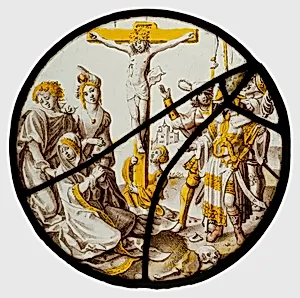
Medium
Colorless glass, silver stain, vitreous paint
Dimensions
Overall Diam.: 9 in. (22.9 cm)
Classification
Glass-Stained
Culture
South Netherlandish
Department
The Cloisters
Museum
Metropolitan Museum of Art, New York, NY
Credit
The Cloisters Collection, 1932
Accession Number
32.24.52
Rights
Public Domain
Tags
Art Historical Context
This roundel, created around 1530–40 in the South Netherlands, captures the Crucifixion in a compact circular format typical of the period. Measuring just nine inches across, it features Christ on the cross surrounded by figures of men and women, rendered in a devotional style that reflects the intense religious focus of early sixteenth-century Northern Europe. Such small-scale stained-glass panels were often installed in church windows, private chapels, or even domestic settings, allowing worshippers to engage intimately with biblical scenes. The work is executed on colorless glass using silver stain and vitreous paint, a technique that allowed artists to achieve luminous yellows and delicate shading without relying solely on colored glass. This method was especially prized in the Netherlands for its ability to create nuanced details and atmospheric effects within a limited space. The roundel’s survival offers a glimpse into the skilled craftsmanship of anonymous glass painters who contributed to both public and personal expressions of faith during the Renaissance. Housed in the Metropolitan Museum’s Cloisters collection, the piece exemplifies the rich tradition of Netherlandish stained glass on the eve of the Reformation, when religious imagery remained central to daily spiritual life. Its modest size and refined execution highlight how art could convey profound narratives with elegance and clarity.