
Route de Pierrefitte à Luz St Sauveur
1853
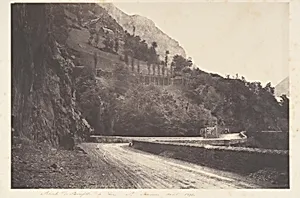
Medium
Salted paper print from paper negative
Dimensions
Sheet: 12 in. × 18 9/16 in. (30.5 × 47.2 cm) Image: 9 3/4 × 13 3/4 in. (24.7 × 35 cm)
Classification
Photographs
Department
Photographs
Museum
Metropolitan Museum of Art, New York, NY
Credit
Gilman Collection, Gift of The Howard Gilman Foundation, 2005
Accession Number
2005.100.503.2
Rights
Public Domain
Tags
About this artwork
This photographs by french artist Joseph Vigier exemplifies the artistic achievements of 1853. French artistic production during this era was central to European cultural life, with artists developing new approaches to composition, technique, and subject matter. Created in salted paper print from paper negative, this work embodies the material practices and technical knowledge of its era. Artists' choices of materials reflected both practical availability and symbolic associations, with differen...
Art Historical Context
In 1853, French photographer Joseph Vigier captured the dramatic beauty of the French Pyrenees in *Route de Pierref à Luz St Sauve*, a salted paper print from a paper negative. This early photograph depicts a winding mountain road flanked by towering peaks and rugged landscapes, inviting viewers to trace the path from the village of Pierrefitte toward the spa town of Luz-Saint-Sauveur. Measuring nearly 10 by 14 inches in its image area, the work showcases the era's pioneering photographic techniques, where light-sensitive paper negatives produced soft, tonal prints rich in atmospheric detail. The salted paper process, perfected in the 1840s, was a hallmark of mid-19th-century photography, allowing artists like Vigier to document remote natural wonders with unprecedented fidelity. France was then at the forefront of European cultural innovation, blending scientific precision with artistic vision in mediums that expanded traditional landscape painting. Vigier's image reflects this shift, emphasizing composition and subject matter in ways that bridged Romanticism and emerging modernism. Today, preserved in the Metropolitan Museum of Art's Gilman Collection, this photograph illuminates 1853's technical and aesthetic advancements. It stands as vital cultural heritage, revealing how photography reshaped perceptions of nature, travel, and artistic practice amid rapid 19th-century changes in patronage and exhibition culture.