
Rüdesheim
1642–44
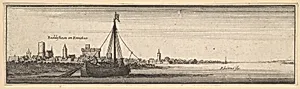
Medium
Etching; second state of two
Dimensions
Sheet: 1 13/16 × 6 1/2 in. (4.6 × 16.5 cm)
Classification
Prints
Department
Drawings and Prints
Museum
Metropolitan Museum of Art, New York, NY
Credit
Gift of Robert Hartshorne, 1918
Accession Number
18.48.1-3
Rights
Public Domain
Tags
Art Historical Context
Visitors to the Metropolitan Museum of Art's Drawings and Prints department are delighted *Rüdesheim*, a etching by Wenceslaus Hollar, crafted between 1642 and1644. This Bohemian-born artist, renowned for his meticulous topographic views, produced this second state of two on a modest sheet measuring just 1 13/16 × 6 1/2 inches (4.6 × 16.5 cm). A gift from Robert Hartsh in 1918, it exemplifies Hollar's mastery during his travels through Europe amid the Thirty Years' War. The print captures the charming town of Rüdes am Rhein, nestled along the winding Rhine River, with ships dotting the waterway—a nod to the vital trade routes of 17th-century Germany. Hollar's etching technique, using acid to bite fine lines into a copper plate, allowed for exquisite detail in capturing architecture, river traffic, and landscape, preserving a vivid snapshot of pre-industrial Rhine life. As part of Hollar's celebrated Rhine series, *Rüdesheim* holds artistic and historical significance, offering a window into Baroque-era Europe. Its small scale belies its precision, making it a gem for print enthusiasts and a testament to etching's power to document fleeting moments.
About the Artist
Wenceslaus Hollar · 1607–1677
Wenceslaus Hollar (1607-1677) was a prolific Bohemian etcher who became one of the most accomplished printmakers of the seventeenth century. Born in Prague, he trained under Matthäus Merian in Frankfurt before entering the service of Thomas Howard, Earl of Arundel, in 1636. Hollar spent most of his career in England, where he produced approximately 2,740 etchings documenting an extraordinary range...