
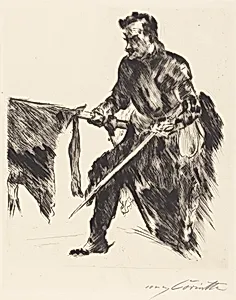
Rudolf Rittner als Florian Geyer (Rudolf Rittner as Florian Geyer)
1914
Medium
drypoint in black on laid paper
Dimensions
plate: 24.8 x 19.8 cm (9 3/4 x 7 13/16 in.) sheet: 34.9 x 24.3 cm (13 3/4 x 9 9/16 in.)
Classification
Department
CG-W
Museum
National Gallery of Art, Washington, D.C.
Credit
Gift of the Marcy Family in memory of Sigbert H. Marcy
Accession Number
1991.210.43
Rights
Public Domain
Art Historical Context
Lovis Corinth's *Rudolf Rittner als Geyer* (1914) captures the intensity of German actor Rudolf Rittner the role of Florian Geyer, a noble knight who led peasants during the 1525 German Peasants' War. on the eve of World War, this drypoint print reflects Corinth's fascination with theater and historical drama, blending portraiture with dramatic expressionism. As a leading figure in the Berlin Secession Corinth shifted from impressionism to a bolder, more emotive style in his later years, often portraying performers to explore human passion and turmoil. Executed in drypoint—a direct intaglio technique where the artist scratches lines into a copper plate, producing a soft, burr-rich texture—this black-on-laid-paper print measures nearly 10 by 8 inches (plate). The medium's velvety depth and subtle tonal variations heighten Rittner's fierce gaze and dynamic pose, evoking the raw energy of stage performance. Laid paper, with its visible chain lines, adds a tactile authenticity prized in early 20th-century printmaking. Housed in the National Gallery of Art as a gift from the Marcy Family, this work exemplifies Corinth's mastery of printmaking amid Germany's vibrant pre-war cultural scene, inviting viewers to ponder the intersection of history, theater, and artistic innovation.
About the Artist
Lovis Corinth · 1858–1925
Lovis Corinth, born Franz Heinrich Louis on July 21, 1858, in Tapiau, East Prussia (now Gvardeysk, Russia), to a tanner father, displayed prodigious drawing talent from childhood. He began formal training at the Königsberg Academy in 1876, then moved to the Academy of Fine Arts in Munich from 1880 to 1884, studying under Ludwig von Löfftz and briefly Franz von Defregger, where he absorbed a Realis...