
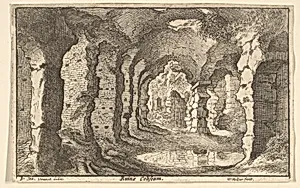
Ruinae Coliseum, from "Roman Ruins"
Medium
Etching; second state of two
Dimensions
Sheet (clipped impression): 2 11/16 × 4 3/16 in. (6.8 × 10.6 cm)
Classification
Prints
Department
Drawings and Prints
Museum
Metropolitan Museum of Art, New York, NY
Credit
Purchase, Joseph Pulitzer Bequest, 1917
Accession Number
17.50.17-379
Rights
Public Domain
Tags
Art Historical Context
This delicate etching captures the enduring majesty of the Colosseum in Rome, reduced to a haunting fragment of its former glory. Created around 1650 as part of the series “Roman Ruins,” the print reflects a seventeenth-century fascination with classical antiquity. Flemish painter Sebastiaen Vrancx likely supplied the compositional design, while renowned etcher Wenceslaus Hollar translated it into fine lines on copper, producing a work that feels both documentary and poetic. Hollar’s precise technique allows every weathered arch and crumbling wall to emerge with remarkable clarity despite the print’s modest size—barely larger than a postcard. The second state reveals subtle refinements to the plate, underscoring the careful craftsmanship involved. Such images helped spread knowledge of Rome’s monuments across Europe at a time when few could travel there. Today, this impression in the Metropolitan Museum’s collection reminds viewers of the passage of time and the power of ruins to inspire both awe and reflection on human achievement.