
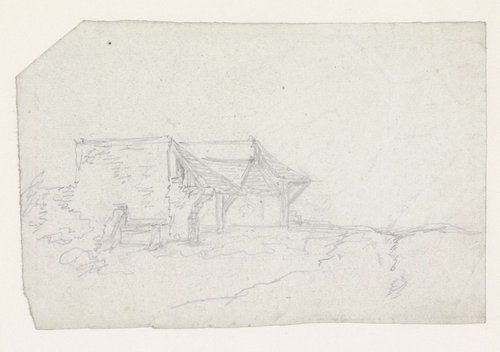
Ruïne van een boerderij
1773 - 1843
Medium
paper
Dimensions
90; 140
Rights
Public Domain
About this artwork
height 90 mm x width 140 mm
Art Historical Context
Georges Michel (1773–1843) was a French landscape painter whose work bridged Neoclassicism and the emerging Romantic movement. Often called the “French Hobbema,” he specialized in atmospheric views of the countryside around Paris, favoring dramatic skies, weathered structures, and the quiet poetry of rural decay. “Ruïne van een boerderij” exemplifies this interest: a modest drawing on paper that records the crumbling remains of a farmhouse, its modest scale—only 90 × 140 mm—suggesting an intimate study rather than a finished exhibition piece. Despite its small size, the work conveys Michel’s sensitivity to texture and light. Rendered on paper, the drawing likely served as a quick plein-air notation or studio sketch, allowing the artist to explore the interplay of broken walls, overgrown vegetation, and shifting shadows. Such studies helped shape the larger canvases for which he is best remembered. Today the sheet offers modern viewers a rare glimpse into Michel’s working process and the early-nineteenth-century fascination with picturesque ruins—symbols of time’s passage and nature’s quiet reclamation of human endeavor.
About the Artist
Georges Michel · 1763–1843
Comment on works: Landscapes