
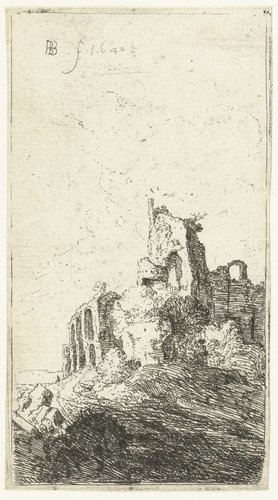
Ruïnes van keizerlijk paleis te Rome
Medium
etching
Dimensions
45; 84
Rights
Public Domain
About this artwork
height 84 mm x width 45 mm
Art Historical Context
Bartholomeus Breen's *Ruïnes van keizerlijkis te Rome* (Ruins of the Imperial Palace in Rome), created in 1640, is a delicate etching capturing the majestic decay of ancient Roman architecture.reenbergh, a Dutch of the Golden Age, spent over a decade in Rome (1619–1630), where he sketched classical ruins firsthand. This small-scale print—measuring just 84 mm high by 45 mm wide—evokes the grandeur of imperial palaces like the Palatine Hill, blending precise architectural details with atmospheric depth. Etching allowed Breenbergh to translate his Romanate landscapes into affordable, reproducible art, a technique he mastered after returning to Amsterdam. The medium's fine lines and tonal gradations highlight crumbling arches and overgrown foliage, emphasizing themes of time's passage—a popular motif in 17th-century Dutch art influenced by Caravaggism and the Utrecht school. This work reflects the era's fascination with antiquity during the Grand Tour, inspiring collectors and travelers. Breenbergh's meticulous style made such scenes accessible, bridging Italian ruins with Northern European audiences and underscoring the enduring allure of Rome's imperial legacy.
About the Artist
Bartholomeus Breenbergh · 1598–1657
Probably was apprenticed in Amsterdam. He was one of the early Dutch italianates, that is, northern artists who travelled to Italy in the 1620s and were inspired by southern landscapes. On his return, he settled in Amsterdam and his landscapes were developed as more severe and monumental, often with historical subjects; strongly influenced by the Pre-Rembrandtists. Comment on works: Landscapes; Ru...