
Ruins in a Mountainous Country
n.d.
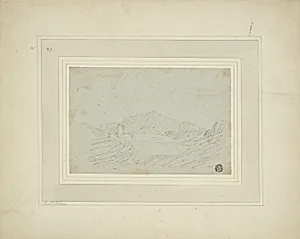
Medium
Charcoal on blue laid paper, laid down on ivory laid paper, laid down on ivory laid paper (2 layers)
Dimensions
13.4 × 20.2 cm (5 5/16 × 8 in.)
Classification
charcoal
Department
Prints and Drawings
Museum
Art Institute of Chicago
Accession Number
83626
Rights
Public Domain
Art Historical Context
Richard Wilson (1713–1782), a pioneering Welsh artist often called the father of British landscape painting, created this evocative study during the height of the 18th-century Grand Tour era. His works frequently depicted classical ruins amid dramatic natural settings, blending observed topography with idealized Italianate scenery inspired by Claude Lorrain and Salvator Rosa. "Ruins in a Mountainous Country" captures this romantic sensibility, inviting viewers to reflect on the passage of time and the enduring power of nature. Executed in charcoal on blue laid paper, the drawing demonstrates Wilson’s skillful use of tonal contrast to suggest atmospheric depth and rugged terrain. The blue support, a favored choice among draftsmen for its mid-tone qualities, enhances the sense of light and shadow across the mountainous composition. Measuring just 13.4 × 20.2 cm, this intimate work likely served as a preparatory study, revealing the artist’s careful attention to composition and mood. Housed in the Art Institute of Chicago’s Prints and Drawings collection, the piece offers modern visitors a window into Wilson’s process and the broader cultural fascination with antiquity and landscape that shaped British art of his time.