
Ruins of a Castle
1825/27
Medium
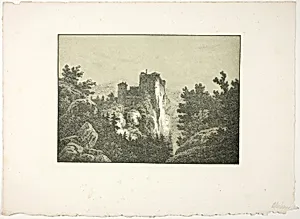
Lithograph with olive-green tint stone, heightened with white gouache, on ivory wove paper
Dimensions
Image: 15.4 × 21.8 cm (6 1/8 × 8 5/8 in.); Sheet: 25.7 × 35 cm (10 1/8 × 13 13/16 in.)
Classification
lithograph
Department
Prints and Drawings
Museum
Art Institute of Chicago
Accession Number
149679
Rights
Public Domain
About this artwork
A former banker who trained at the Berlin Arts Academy, Carl Blechen also used his flair for the dramatic as a set designer for theatrical productions. Ruins of a Castle is among the three etchings and 14 lithographs produced by the artist featuring romantic subjects such as ruins, hermits, and pilgrims in darkly evocative landscapes. These works demonstrate the continuing influence on Blechen of Caspar David Friedrich, who staged the natural world as a form of religious allegory.
Art Historical Context
Carl Blechen’s *Ruins of a Castle* captures the Romantic era’s deep fascination with the past and the poetry of decay. Created between 1825 and 1827, the lithograph depicts crumbling medieval walls overtaken by nature, a motif that resonated strongly in early nineteenth-century Germany. Blechen, known for his atmospheric landscapes, invites viewers to contemplate time’s passage and the fragile boundary between human achievement and the natural world. The work’s medium adds further richness. Printed as a lithograph on tinted stone and then heightened with white gouache, it combines the reproducibility of the new printmaking technique with the individuality of handwork. This approach allowed Blechen to achieve luminous effects of light and shadow, giving the ruins a haunting, almost theatrical presence on the ivory paper. Today housed in the Art Institute of Chicago’s collection of prints and drawings, the sheet exemplifies how Romantic artists used emerging graphic media to share intimate, moody visions with a wider audience. Its modest scale encourages close looking, rewarding visitors with subtle contrasts between the cool olive-green tint and the bright gouache highlights that suggest moonlight or fading daylight on ancient stone.