
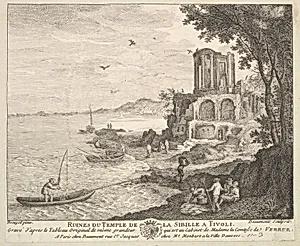
Ruins of the Temple of the Sybil in Tivoli (Ruines du Temple de la Sibille a Tivoli) after the painting in the collection of Madame la Comtesse de Verrue
Medium
Etching and engraving
Dimensions
Sheet: 5 15/16 x 7 3/16 in. (15.1 x 18.2 cm)
Classification
Prints
Department
Drawings and Prints
Museum
Metropolitan Museum of Art, New York, NY
Credit
The Elisha Whittelsey Collection, The Elisha Whittelsey Fund, 1949
Accession Number
49.95.1456
Rights
Public Domain
Tags
Art Historical Context
This delicate etching and engraving captures the evocative ruins of the Temple of the Sibyl inoli, an ancient Roman site near Rome celebrated for its picturesque decay. The composition, reproduced after a painting once in the collection of Madame Comtesse de Verrue features crumbling arches and columns framed by a serene landscape, with boats gliding on a nearby river and small human figures adding a sense of scale and timeless activity. Measuring just under 6 by 7 inches, the print invites viewers to ponder the passage of time amid classical grandeur. Created by Pierre François Beaumont and Monbart—possibly drawing from Jan Brueghel the Elder's influence—this work exemplifies 18th-century reproductive printmaking. Etching and engraving techniques allowed intricate details, from weathered stone textures to shimmering water, to be faithfully translated from oil paintings to paper, making elite art accessible to collectors during the Grand Tour era. Such prints fueled a cultural obsession with antiquity, blending historical reverence with emerging Romantic sensibilities. Housed in the Metropolitan Museum of Art's Drawings and Prints department through The Elisha Whittelsey Collection, this piece highlights how prints preserved and popularized Europe's architectural heritage for generations of admirers.
About the Artist
Pierre François Beaumont|Jan Brueghel the Elder|Pierre François Beaumont|Monbart (French|Netherlandish|French|Flemish) · 1719 |1568 |1719 |1700 –1777 |1625 |1777 |1785
French, 1719 ?–after 1777|Netherlandish, Brussels 1568–1625 Antwerp|French, 1719 ?–after 1777|Flemish, active Antwerp mid-18th century