
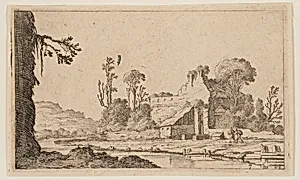
Ruins Transformed into a Farm on a River, from Twelve Landscapes
c. 1605-1650
Medium
Etching on ivory laid paper
Dimensions
Plate: 6.7 × 11.3 cm (2 11/16 × 4 1/2 in.)
Classification
etching
Department
Prints and Drawings
Museum
Art Institute of Chicago
Accession Number
268019
Rights
Public Domain
Art Historical Context
Welcome to the Art Institute of Chicago's Prints Drawings collection, where Gillis van Scheyndel'sRuins Transformed into Farm on a River*, the series *Twelve Landscapes* (c. 1605–1650), captures the interplay of decay and renewal. This intimate etching, measuring just 6.7 × 11.3 cm, depicts ancient ruins repurposed as a humble farmstead along a serene riverbank—a motif blending classical antiquity with everyday Dutch rural life during the Golden Age. Van Scheyndel, a Dutch printmaker active in the early 17th century, mastered etching, an intaglio technique where acid bites designs into a metal plate for richly detailed impressions on fine ivory laid paper. This medium allowed affordable dissemination of landscapes to collectors, emphasizing meticulous linework that evokes depth, texture, and atmospheric light in tiny formats. The series reflects the era's fascination with *ruinenscapes*, symbolizing time's passage and humanity's adaptation to nature amid Holland's prosperity and reclamation of land from water. Perfect for contemplation, this work invites visitors to ponder resilience: overgrown arches shelter livestock, while the flowing river underscores life's continuity. A gem of Northern European printmaking, it showcases how etchings democratized art, bridging elite patronage and public appreciation.