
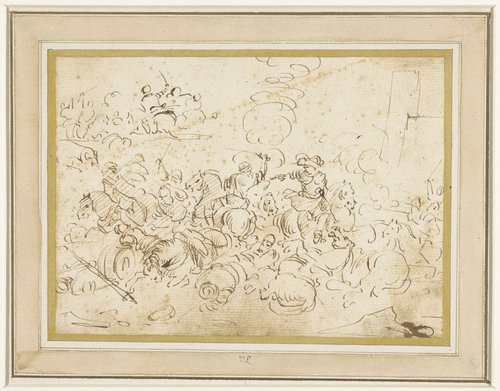
Ruitergevecht
1631 - 1676
Medium
pen
Dimensions
228; 150
Rights
Public Domain
About this artwork
height 150 mm x width 228 mm
Art Historical Context
**Ruitergevecht (Cavalry Battle)***Jacques Courtois, c. 1631–167, Pen, 150 × 228 mm* Jacques Courtois, also known as *il Borgognone*, was a 17th-century French artist renowned for his dynamic battle scenes, blending French vigor with Italian Baroque flair. Active primarily in Rome, he captured the chaos of warfare with swirling compositions of horses and soldiers, influencing later battle painters. *Ruitergevecht*, Dutch for "Cavalry," exemplifies his specialty in equestrian combat, likely a preparatory drawing or standalone sketch rendered in pen. This intimate pen work, modest in scale at 150 × 228 mm, highlights Courtois's mastery of line and movement during the Baroque era—a time when Europe was rife with conflicts like the Thirty Years' War. The medium's immediacy allowed for fluid, energetic strokes that convey motion and fury, a technique rooted in the draftsmanship traditions of artists like Salvator Rosa. Such drawings were prized in artistic circles for study or collection, offering a window into the raw energy behind his larger oil paintings. Today, *Ruitergevecht* invites visitors to appreciate the artistry in historical violence, reminding us how 17th-century draftsmen like Courtois transformed pen on paper into vivid narratives of human strife.
About the Artist
Jacques Courtois · 1621–1676
A specialist in battle paintings, he also painted religious and other scenes. As a teenager, Courtois left France for Italy with his young brother, Guillaume. He drew military campaigns, then studied in Bologna, Florence, and Siena, arriving in Rome by 1638. He worked primarily in Italy. He joined the Jesuit order in 1657.