
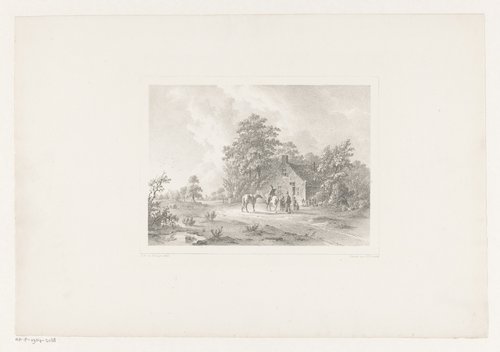
Ruiters voor een herberg
in or before 1835 - 1848
Medium
lithography
Dimensions
430; 295
Rights
Public Domain
About this artwork
lithografie
Art Historical Context
Arie Ketting de Koningh’s *Ruiters voor een herberg* captures a lively roadside scene in which mounted travelers pause before a rustic inn. Created as a lithograph between1835 and 1848, the work measures roughly 295 × 430 mm and reflects the nineteenth-century taste for genre subjects drawn from everyday Dutch life. Though little is known of the artist’s personal biography, the print belongs to a period when lithography had become a favored medium for circulating affordable images of local customs and landscapes. Lithography, a planographic process invented in the late eighteenth century, allowed artists to draw directly on stone with greasy crayons, producing rich tonal gradations and fine detail without the labor of engraving. De Koningh’s sheet demonstrates these qualities through its atmospheric rendering of figures, horses, and architecture, evoking the convivial atmosphere of coaching inns that still dotted Dutch roads in the 1830s and 1840s. As both a technical and cultural document, the lithograph connects viewers to a transitional era when traditional travel by horse was giving way to emerging rail networks. Its modest scale and reproductive nature made such scenes accessible beyond elite collections, helping shape a shared visual memory of Dutch rural hospitality during the Romantic period.