
Running-script Calligraphic Couplet
18th century
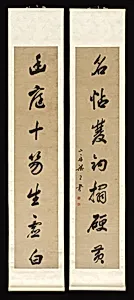
Medium
Pair of hanging scrolls; ink on paper
Dimensions
Image (Each): 51 1/4 x 10 1/8 in. (130.2 x 25.7 cm) Overall with mounting (Each): 65 1/4 x 13 in. (165.7 x 33 cm)
Classification
Calligraphy
Culture & Period
China · Qing dynasty (1644–1911)
Department
Asian Art
Museum
Metropolitan Museum of Art, New York, NY
Credit
Gift of Chan-hua Mao, 1978
Accession Number
1978.23a, b
Rights
Public Domain
Art Historical Context
Behold the elegant *Running-script Calligraphic Cou* by Liang Tongshu a masterful Qing dynasty (1644–1911) scholar-official and calligrapher active in the 18th. This pair of hanging, executed in fluid ink on paper, measures an impressive 51¼ x 10⅛ inches each (image area), designed to grace the walls of refined Chinese homes or studies. Gifted to the Metropolitan Museum of Art 1978 by Chan-hua Mao, these works exemplify the pinnacle of literati artistry during China's last imperial era. Liang's running script (xingshu)—a dynamic style bridging the structured poise of regular script and the freewheeling energy of cursive—captures the rhythm of thought and brush in motion. Each stroke dances with controlled abandon, revealing the artist's profound mastery of brush pressure, ink density, and composition. Couplets like this often conveyed poetic wisdom or moral exhortations, prized for their aesthetic harmony and intellectual depth. In Qing culture, such scrolls were not mere decorations but symbols of cultivation, hung in pairs for symmetry and auspiciousness during festivals or scholarly gatherings. They invite viewers to linger, tracing the calligrapher's hand as a window into 18th-century elegance and the enduring reverence for calligraphy as China's supreme art form.