
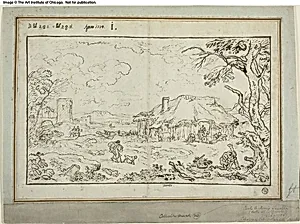
Rural Crossroads, with Farm Buildings in Foreground
Medium
Pen and brown ink, over black chalk, on ivory laid paper, laid down on pale green laid paper
Dimensions
29.3 × 42.2 cm (11 9/16 × 16 5/8 in.)
Classification
pen and ink drawings
Department
Prints and Drawings
Museum
Art Institute of Chicago
Accession Number
81009
Rights
Public Domain
Art Historical Context
Carlo Antonio Tavella’s “Rural Crossroads, with Farm Buildings in Foreground” captures a quiet moment in the Italian countryside. Created in 1734, late in the Genoese artist’s career, the drawing reflects the period’s growing interest in naturalistic landscape views that celebrated everyday rural life rather than grand historical subjects. Tavella, known for his sensitive depictions of the Ligurian hills and valleys, often worked in both oil and on paper, using drawings like this to record the play of light and texture across open fields and modest architecture. Executed in pen and brown ink over black chalk on ivory laid paper, the work demonstrates the artist’s command of line and subtle tonal modeling. The medium allows for crisp architectural details in the foreground buildings while softer chalk underdrawing suggests atmospheric depth in the distant crossroads. Measuring just under 12 by 17 inches, the sheet was later mounted on pale green paper, a presentation choice that enhances its delicate ink tones and highlights its status as a finished work of art rather than a mere study. Today in the Art Institute of Chicago’s Prints and Drawings collection, the drawing offers modern viewers an intimate glimpse into eighteenth-century perceptions of the Italian landscape. Its balanced composition and careful observation of farm structures invite us to appreciate how Tavella transformed ordinary scenery into a scene of enduring charm and quiet dignity.
About the Artist
Carlo Antonio Tavella · 1668–1738
**Carlo Antonio Tavella** (1668–1738) was an Italian painter of the Baroque period, active mainly in Genoa. Born in Milan as the son of Domenico Tavella, a Genoese merchant, he trained initially under the painter Giuseppe Merati before studying with Johann Gruembroech (also known as Greuenbrech or il Solfarolo). In 1695 he collaborated with the Dutch painter Pieter Mulier II, known as Cavaliere Te...