
Rush Light and Candle Holder
c. 1938
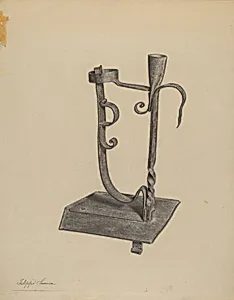
Medium
graphite on paperboard
Dimensions
overall: 29 x 23.1 cm (11 7/16 x 9 1/8 in.)
Classification
Index of American Design
Department
CG-W
Museum
National Gallery of Art, Washington, D.C.
Credit
Index of American Design
Accession Number
1943.8.12152
Rights
Public Domain
Art Historical Context
In the humble glow of early American homes, the *Rush Light and Candle Holder (c. 1938) by Filippo Porreca a poignant slice of everyday ingenuity. Rendered in graphite on paperboard, precise 29 x 23.1 cm drawing depicts a simple yet essential tool: a rush light, made by dipping the pith of rushes in animal fat, alongside a sturdy candle holder. These low-cost illuminators were vital for colonial and frontier households before widespread access to manufactured candles or electricity, symbolizing resourcefulness amid scarcity. Created as part of the Index of American Design—a Federal Art Project under the Works Progress Administration (WPA) during the Great Depression—Porreca's work preserves vanishing folk artifacts. Launched in 1935, the Index commissioned artists to document over 15,000 American design objects through detailed renderings, safeguarding cultural heritage for future generations. Graphite's fine lines allowed Porreca to highlight textures, forms, and subtle patinas with scientific accuracy, blending artistry and scholarship. Housed in the National Gallery of Art, this piece invites us to appreciate the unadorned beauty of utilitarian design. It reminds visitors how ordinary objects embody resilience, bridging 18th-century practicality with 20th-century preservation efforts.
About the Artist
Filippo Porreca · 1855–present
Filippo Porreca is an artist for whom documented biographical information is scarce. No confirmed dates of birth or death have been established, and his nationality remains uncertain, preventing confident placement of his work within a specific national or regional tradition. The works attributed to Porreca indicate an artist with training in a recognizable technical tradition, but without archiv...