
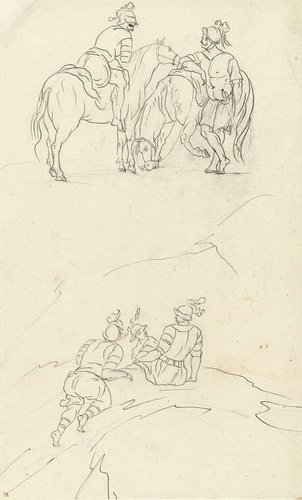
Rustende ruiters
1768 - 1836
Medium
pen
Dimensions
383; 233
Rights
Public Domain
About this artwork
collector's mark, recto, lower left: Lugt 494a
Art Historical Context
**Rustende Ruiters by Carle Vernet** le Vernet (1758–1836), a master of equestrian art in late 18th- and early 19th-century France, the quiet moment of respite in *Rustende Ruiters* ("ing Riders"). This pen drawing, measuring 383 × 233 mm, reflects Vernet's lifelong fascination with horses and cavalry, honed during the turbulent Napoleonic era. As a painter, draughtsman, and engraver from a dynasty of artists—son of marine painter Joseph Vernet and father to Horace Vernet—he excelled in dynamic scenes of military life, blending neoclassical precision with emerging romantic energy. Executed in pen, likely ink on paper, the work showcases Vernet's virtuoso technique: fluid lines that convey motion even in stillness, anatomical accuracy of horse and rider, and atmospheric depth. Such sketches were preparatory studies or independent works, valued for their immediacy and portability. The collector's mark (Lugt 494a) on the lower left verso hints at its esteemed provenance, linking it to discerning European connoisseurs who prized Vernet's contributions to genre scenes. This intimate drawing invites us to ponder the human-horse bond amid war's pauses, embodying Vernet's legacy as chronicler of France's heroic age. A gem for equestrian art lovers! (198 words)
About the Artist
Carle Vernet · 1758–1836
Comment on works: Horses; Landscapes; History; Battles