
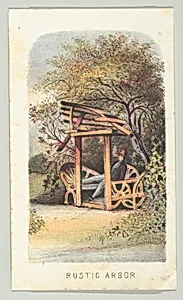
Rustic Arbor, from the series, Views in Central Park, New York, Part 2
Medium
Color lithograph
Dimensions
Sheet: 4 in. × 2 3/8 in. (10.2 × 6.1 cm)
Classification
Prints|Ephemera
Department
Drawings and Prints
Museum
Metropolitan Museum of Art, New York, NY
Credit
The Jefferson R. Burdick Collection, Gift of Jefferson R. Burdick, 1947
Accession Number
47.91.25(37)
Rights
Public Domain
Tags
Art Historical Context
Step into the lush greenery of New York's fledgling Central Park with *Rustic Arbor*, a delicate color lithograph from Louis Prang & Co.'s 1864 series *Views in Central Park, New York, Part *. Created just six years after the park's opening in 1858, this tiny print (measuring a mere 4 × 2⅜ inches) captures a picturesque rustic arbor framed by trees, with figures of men adding a touch of everyday life to the scene. Central Park, designed by Frederick Law Olmsted and Calvert Vaux as an urban oasis, symbolized democratic leisure amid rapid industrialization, and such views celebrated its idyllic nooks. Louis Prang & Co., pioneers of chromolithography in America, mastered this technique to produce vibrant, affordable color prints that mimicked paintings. By layering tinted inks through multiple lithographic stones, they brought naturalistic hues to mass audiences—revolutionary for ephemera like this, often collected as souvenirs or traded cards. Housed in the Metropolitan Museum of Art's Jefferson R. Burdick Collection, it highlights how 19th-century printing democratized art, making scenic escapes accessible beyond elite canvases. This charming piece evokes a bygone era of park strolls, reminding us of Central Park's enduring role as a vital green lung in the city.
About the Artist
Louis Prang & Co. · 1800–1950
Louis Prang & Co. was the Boston printing firm that introduced the Christmas card to the American public and elevated chromolithography to the level of a serious art form. Its founder, Louis Prang (1824–1909), was born in Breslau, Prussia (now Wrocław, Poland), where he trained as a cloth printer and dyer. After participating in revolutionary activity against the Prussian government, he fled first...