
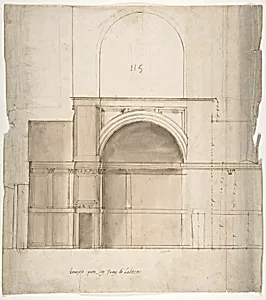
S. Giovanni Laterno, Oratorio della Santa Croce, section (recto) blank (verso)
early to mid-16th century
Medium
Dark brown ink, black chalk, and incised lines
Dimensions
sheet: 14 5/8 x 13 1/4 in. (37.2 x 33.7 cm)
Classification
Drawings|Ornament & Architecture
Department
Drawings and Prints
Museum
Metropolitan Museum of Art, New York, NY
Credit
Purchase, Rogers Fund, Joseph Pulitzer Bequest, and Mark J. Millard Gift, 1968
Accession Number
68.769.44
Rights
Public Domain
Tags
Art Historical Context
This exquisite 16th-century drawing, created by an anonymous French artist captures a detailed section of the Oratorio della Santa Croce at S. Giovanni in Laterano, one of Rome's most ancient basilicas. Dating to the early to mid-1500s, it reflects the era's fascination among French artists with Italian Renaissance architecture. During this period, northern European draughtsmen traveled to Italy to study classical forms, arches, and ornate details, blending them into emerging French styles like Mannerism. The recto side presents the architectural elevation, while the verso remains, suggesting this was a focused study sheet. Rendered in dark brown ink, black chalk, and incised lines on a generous 14 5/8 x 13 1/4-inch sheet, the work showcases precise Renaissance techniques. Incised lines—scratched into the surface—indicate it may have served as a template for transfer to another surface, a common practice for architects and ornament designers. The emphasis on arches highlights their structural and decorative role in Roman ecclesiastical spaces, underscoring the drawing's place in the tradition of architectural ornament studies. Acquired by The Metropolitan Museum of Art in 1968 through generous funds, this piece offers visitors a window into 16th-century cross-cultural exchange, where French precision met Italian grandeur in the intimate medium of drawing.