
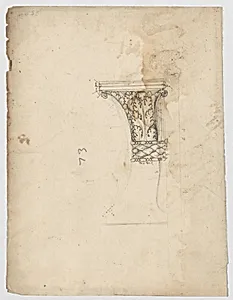
S. Maria in Trastevere, Ionic capital, side elevation (recto); Unidentified, Ionic capital volute, construction diagram (verso)
early to mid-16th century
Medium
Dark brown ink, black chalk, and incised lines
Dimensions
sheet: 8 3/4 x 11 9/16 in. (22.2 x 29.3 cm)
Classification
Drawings|Ornament & Architecture
Department
Drawings and Prints
Museum
Metropolitan Museum of Art, New York, NY
Credit
Purchase, Rogers Fund, Joseph Pulitzer Bequest, and Mark J. Millard Gift, 1968
Accession Number
68.769.14
Rights
Public Domain
Tags
Art Historical Context
This delicate 16th-century drawing created by an anonymous French artist captures the side elevation of an Ionic capital the basilica of Santa Maria in Trastevere Rome on its recto side. Ionic capitals, with their signature volutes resembling scrolling rams' horns, originated in ancient Greek architecture and were revived during the Renaissance as symbols of classical harmony and proportion. The verso features a precise construction diagram of an unidentified Ionic capital volute, the artist's methodical approach to understanding and replicating these ornate elements. Executed in dark brown ink, black chalk, and incised lines on a modest sheet, the work exemplifies the technical precision of Renaissance architectural draughtsmanship. Incised lines—scored into the paper—allowed for easy tracing or transfer, a practical technique used by architects and designers traveling through Italy to document treasures for northern European patrons. Housed in the Metropolitan Museum of Art's Drawings and Prints department, this piece highlights the era's fervent study of antiquity, bridging medieval Romanesque churches like Santa Maria with the humanist revival of Greco-Roman forms. Such drawings were vital tools for disseminating architectural knowledge across Europe, influencing the ornate styles of the French Renaissance. Visitors will appreciate its blend of scholarly observation and artistic finesse, a window into how 16th-century minds reimagined the past.