
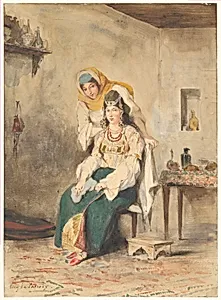
Saada, the Wife of Abraham Ben-Chimol, and Préciada, One of Their Daughters
Eugène Delacroix, 1832
About this artwork
In 1832, during his transformative journey to Morocco as part of a French diplomatic mission, Eugèneacroix, the preeminent French Romantic artist, this intimate watercolor portrait. Titled *Saada, the Wife Abraham Ben-Chimol and Préciada, of Their Daughters*, it captures a tender mother-daughter moment amid the vibrant North African culture that profoundly influenced Delacroix's work. Staying with the Jewish merchant Abraham Ben-Chimol in Tangier, Delacroix sketched local life, blending exoticism with acute observation in his signature Romantic style—emphasizing emotion, color, and exotic subjects over classical precision. Executed in watercolor over graphite on wove paper, the small-scale drawing (just 8-3/4 x 6-3/8 inches) showcases Delacroix's masterful use of loose, fluid washes to evoke luminous skin tones and rich fabrics, with graphite underdrawing providing precise contours. This technique allowed for spontaneity, typical of his travel studies, which later inspired grand oil paintings like *Women of Algiers*. Housed in the Metropolitan Museum of Art's Drawings and Prints department, this bequest from Walter C. Baker highlights Delacroix's role in Orientalism, offering a window into 19th-century cross-cultural encounters and the everyday grace of Moroccan Jewish women. A gem for visitors, it reveals the artist's fascination with the "other," rendered with warmth and immediacy.