
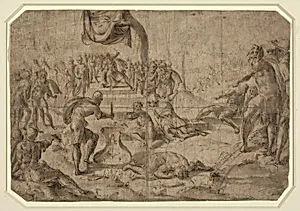
Sacrifice Scene (Gaius Mucius Scaevola?)
late 16th century
Medium
pen and brown ink with brown wash on laid paper
Dimensions
overall (octagon): 24.7 x 35.7 cm (9 3/4 x 14 1/16 in.)
Classification
Drawing
Department
CG-E
Museum
National Gallery of Art, Washington, D.C.
Credit
Rosenwald Collection
Accession Number
1943.3.8878
Rights
Public Domain
Art Historical Context
This evocative drawing, titled *Sacrifice Scene (Gaius Mucius Scae?)*, hails from the late th century and is attributed to an anonymous Netherlandish artist Executed in pen and brown ink with brown wash on laid paper, measures an unusual octagonal shape of .7 x 35.7 cm, suggesting it may have been designed for a specific frame or album. The medium—reminiscent of Northern Renaissance drafting techniques—allowed for precise line work to define figures and architecture, while the brown wash added subtle tonal depth, evoking dramatic light and shadow in a compact composition. The scene likely depicts the legendary Roman hero Gaius Mucius Scaevola, who, after failing to assassinate the Etruscan king Lars Porsena around 508 BCE, thrust his hand into a sacrificial fire to demonstrate unyielding Roman resolve. This classical tale, drawn from Livy's *History of Rome*, resonated deeply in 16th-century Northern Europe, where artists revived antiquity to explore themes of stoicism and patriotism amid religious and political turmoil. Netherlandish draughtsmen, influenced by masters like Hieronymus Bosch or Albrecht Dürer, favored such moralistic narratives in ink studies, often preparatory for paintings or prints. Now housed in the National Gallery of Art's Rosenwald Collection (Department CG-E), this work exemplifies the era's fascination with heroism and sacrifice, offering visitors a window into Renaissance reinterpretations of ancient virtue through masterful, economical artistry.