
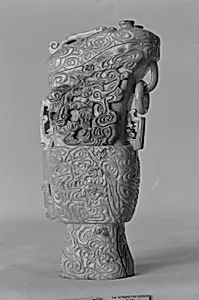
Sacrificial Vessel with Cover
Unknown Artist
1796–1875
Medium
Jadeite, creamy white with cloudings, veinings and streaks of bright emerald green
Dimensions
H. 6 in. (15.2 cm); W. 3 1/4 in. (8.3 cm); D. 1 3/8 in. (3.5 cm)
Classification
Jade
Culture & Period
China · Qing dynasty (1644–1911)
Department
Asian Art
Museum
Metropolitan Museum of Art, New York, NY
Credit
Gift of Heber R. Bishop, 1902
Accession Number
02.18.720a, b
Rights
Public Domain
Art Historical Context
Behold the *Sacrificial Vessel with Cover*, a exquisite jadeite from China's Qing dynasty (1644–1), crafted between 1796 and1875. Standing just 6 inches tall, this slender vessel—measuring 3¼ inches wide and 1½ inches deep—was likely used in ritual offerings, embodying the reverence for jade in Chinese culture. Gifted to the Metropolitan Museum of Art in1902 by Heber R. Bishop, it now the Asian Art department, testament to the era's masterful lapidary arts. Jadeite, prized above all other stones for its luminous translucency and symbolic purity, forms the vessel's creamy white body, dramatically veined and streaked with vibrant emerald green. These natural cloudings and inclusions were not flaws but celebrated features, highlighting the artisan's skill in selecting and carving rare material without waste. During the Qing period, jade carving reached new heights of refinement, often for imperial or ceremonial use, reflecting Confucian ideals of harmony and immortality. This unknown artist's work invites us to ponder ancient rituals: incense or offerings once placed within, its cover sealing sacred intent. A small yet profound object, it captures the Qing court's opulent aesthetic and enduring spiritual legacy.