
Saint Agnes
Unknown Artist
early 20th century (original dated 6th century)
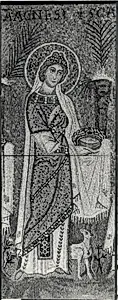
Medium
Tesserae, glass in wooden frame
Dimensions
Overall: 101 1/8 x 40 x 1 1/2 in. (256.8 x 101.6 x 3.8 cm) a-head and upper torso: 51 1/2 x 40 x 1 1/2 in. (130.8 x 101.6 x 3.8 cm) b-lower section: 49 3/4 x 40 x 1 1/2 in. (126.4 x 101.6 x 3.8 cm)
Classification
Reproductions-Mosaics
Culture
Byzantine
Department
Medieval Art
Museum
Metropolitan Museum of Art, New York, NY
Credit
Johnston Fund, 1924
Accession Number
24.144.5a, b
Rights
Public Domain
Tags
Art Historical Context
This striking mosaic reproduction portrays Saint Agnes, a revered early Christian martyr symbolizing purity and faith, rendered in the grand tradition of Byzantine art. Dating to the early 20th century, it faithfully recreates a 6th-century original, capturing the saint's serene visage and upper body in a monumental scale—over eight feet tall when assembled. Housed in the Metropolitan Museum of Art's Medieval Art department, this piece evokes the opulent mosaics that once adorned Byzantine churches, such as those in Ravenna or Constantinople, where saints served as spiritual guardians for worshippers. Crafted from tesserae—tiny, shimmering cubes of glass set into a wooden frame—the artwork exemplifies the luminous technique of Byzantine mosaics. These glass pieces, often backed with gold or silver, reflect light to create a divine glow, drawing the viewer's eye heavenward. The mosaic's division into head/upper torso and lower sections highlights its modular construction, a practical method for transporting or conserving large-scale religious imagery. As a "Reproduction-Mosaic" funded by the Johnston Fund in 1924, it bridges ancient devotion with modern appreciation, allowing visitors to experience the enduring cultural power of Byzantine portraiture. Saint Agnes, often depicted with a lamb (echoing her name's Latin root), reminds us of Christianity's triumph in the early medieval world.