
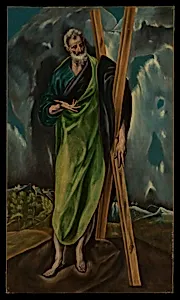
Saint Andrew
ca. 1610
Medium
Oil on canvas
Dimensions
43 1/4 x 25 1/4 in. (109.9 x 64.1 cm)
Classification
Paintings
Department
European Paintings
Museum
Metropolitan Museum of Art, New York, NY
Credit
Bequest of Stephen C. Clark, 1960
Accession Number
61.101.8
Rights
Public Domain
Tags
Art Historical Context
El Greco's *Saint Andrew* (ca. 1610), a striking oil on canvas portrait now at the Metropolitan Museum of Art captures the apostle in a dramatic bust-length pose, clutching the X-shaped cross symbolizing his martyrdom. Painted late in the artist's career in Toledo, Spain, this exemplifies El Greco's unique fusion of Byzantine roots and Mannerist exaggeration. Born Domenikos Theotokopoulos in Crete, he blended Eastern iconographic traditions with Western Renaissance techniques, creating ethereal, spiritually charged figures that seem to transcend earthly bounds. The painting's artistic significance lies in El Greco's masterful use of oil on canvas to achieve vivid, jewel-like colors and dynamic chiaroscuro lighting, which heightens the saint's intense, upward gaze and elongated features. These hallmarks of his style—elongated proportions, swirling drapery, and emotional fervor—bridge Mannerism and the emerging Baroque, influencing later Spanish masters like Velázquez. At 43¼ x 25¼ inches, its intimate scale invites viewers into a profound meditation on faith. As one of several apostle portraits El Greco produced, *Saint Andrew* reflects Counter-Reformation zeal, portraying saints as vivid intercessors. Bequeathed to the Met in 1960, it remains a testament to the artist's visionary genius, drawing visitors into the mystical world of 17th-century Spanish devotion.
About the Artist
El Greco · 1540–1614
El Greco, "The Greek," worked in Spain but signed his paintings with his Greek name, Domenikos Theotokopoulos. His work shows the influence of the art of Crete, his birthplace; Crete was a center for the Byzantine artistic tradition, emphasizing abstraction and pattern rather than recording natural appearances. From 1568 to 1577, El Greco lived in Venice and Rome, where Titian's broad brushwork an...