
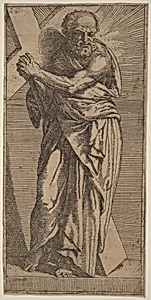
Saint Andrew
1501 to 1550
Medium
etching
Dimensions
sheet (trimmed to plate mark): 29.1 × 14.1 cm (11 7/16 × 5 9/16 in.)
Classification
Department
CG-E
Museum
National Gallery of Art, Washington, D.C.
Credit
Andrew W. Mellon Fund
Accession Number
1976.45.3
Rights
Public Domain
Art Historical Context
Bartolomeo Passarotti’s etching *Saint Andrew* presents the apostle in a tall, narrow format that emphasizes his elongated figure. Created in the first half of the sixteenth century, the print measures roughly 29 by 14 centimeters, a modest size typical of devotional images meant for private contemplation or inclusion in albums. As a Bolognese artist active during the late Renaissance, Passarotti helped expand the reach of religious subjects through the relatively new medium of etching. Etching offered artists greater freedom than engraving, allowing fluid lines and subtle tonal effects produced by acid biting into the copper plate. Passarotti’s choice of this technique reflects the growing demand for affordable yet refined prints that could circulate widely across Europe. Acquired by the National Gallery of Art through the Andrew W. Mellon Fund, the work preserves an example of how printmaking democratized sacred imagery during this period. Saint Andrew, one of Christ’s earliest followers, appears here as a solitary, contemplative figure. The print’s intimate scale encourages close viewing, inviting visitors to appreciate both the technical skill of the etcher and the enduring spiritual resonance of the subject.
About the Artist
Bartolomeo Passarotti · 1529–1592
Comment on works: History, Portraits