
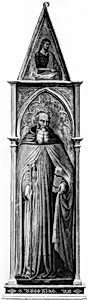
Saint Anthony Abbot (with Saint John the Baptist)
Medium
Tempera on wood, gold ground
Dimensions
Overall, with shaped top and engaged (modern) frame, 58 5/8 x 16 1/2 in. (148.9 x 41.9 cm); Saint Anthony 39 1/2 x 11 3/4 in. (100.3 x 29.8 cm); Saint John 12 3/4 x 8 7/8 in. (32.4 x 22.5 cm)
Classification
Paintings
Department
European Paintings
Museum
Metropolitan Museum of Art, New York, NY
Credit
Theodore M. Davis Collection, Bequest of Theodore M. Davis, 1915
Accession Number
30.95.265
Rights
Public Domain
Tags
Art Historical Context
This elegant panel by the Sienese painter Martino di Bartolommeo di Biagio presents Saint Anthony Abbot as its central figure, accompanied by a smaller image of Saint John Baptist. Created in tempera on wood with a gold ground, the work reflects the devotional art of late medieval and early Renaissance Italy. Such paintings were typically part of larger altarpieces in churches, where the luminous gold background symbolized divine light and the heavenly realm, drawing worshippers into contemplation. Saint Anthony, revered as the founder of monasticism, and Saint John the Baptist, the forerunner of Christ, were popular subjects that embodied spiritual devotion and ascetic ideals. The shaped top and engaged frame suggest this panel once formed part of a multi-tiered altarpiece, a common format in Sienese workshops of the period. Martino’s careful rendering of the saints’ robes and attributes highlights the artist’s attention to symbolic detail within the graceful, elongated figures characteristic of Sienese painting. Housed in the Metropolitan Museum of Art’s European Paintings collection, this piece offers visitors a glimpse into the rich tradition of religious imagery that shaped daily faith in fourteenth- and fifteenth-century Tuscany. Its modest scale and intimate pairing of saints invite quiet reflection on themes of solitude, prophecy, and holiness.