
Saint Anthony
1551 to 1600
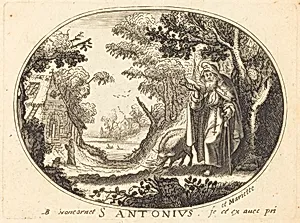
Medium
engraving
Classification
Department
CG-E
Museum
National Gallery of Art, Washington, D.C.
Credit
Rosenwald Collection
Accession Number
1964.8.1292
Rights
Public Domain
Art Historical Context
Balthasar Moncornet’s engraving *Saint Anthony*, created between 1551 and 1600, offers a fine example of how printmaking helped spread religious imagery across Europe during the late Renaissance. As an engraving, the work would have been produced by incising lines into a metal plate, allowing for multiple impressions that could reach wide audiences beyond the church or court. This medium played a vital role in making devotional subjects accessible to everyday viewers. Saint Anthony, a figure often associated with temptation and spiritual endurance, appears here in a format suited to personal reflection or study. Moncornet, active as both engraver and publisher, contributed to a flourishing print culture that blended artistic skill with religious purpose. The piece now resides in the National Gallery of Art’s Rosenwald Collection, where it continues to illustrate the enduring appeal of devotional prints. Visitors can appreciate how such works combined technical precision with spiritual meaning, preserving centuries-old stories through a reproducible art form.
About the Artist
Balthasar Moncornet · 1600–1668
Balthasar Moncornet (c. 1600–1668) was a French engraver and print publisher who became one of the most prolific portrait printmakers of seventeenth-century France. Born in Rouen, he established a highly productive workshop in Paris on the Rue Saint-Jacques, the traditional center of the French print trade. Despite being blind in one eye — a remarkable handicap for an engraver — Moncornet produced...