
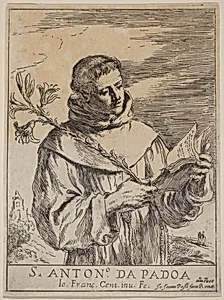
Saint Anthony of Padua
Medium
etching on laid paper
Dimensions
sheet (trimmed to platemark): 15 × 11.2 cm (5 7/8 × 4 7/16 in.)
Classification
Department
CG-E
Museum
National Gallery of Art, Washington, D.C.
Credit
Ailsa Mellon Bruce Fund
Accession Number
1972.65.23
Rights
Public Domain
Art Historical Context
Giovanni Francesco Barbieri, known as Guercino, created this intimate etching of Saint Anthony of Padua in the 1630s during the height of the Italian Baroque period. The saint, a beloved Franciscan preacher and miracle-worker, is depicted with quiet reverence, his expressive face and flowing robes rendered through delicate, fluid lines. Guercino’s dynamic style, marked by dramatic contrasts of light and shadow, brings emotional depth to this small devotional image, inviting viewers into a moment of spiritual reflection. As an etching on laid paper, the work highlights the artist’s skill in a medium that allowed for intricate detail and wider circulation of religious imagery. Measuring just 15 by 11.2 centimeters, the print’s modest scale suggests it was intended for private contemplation rather than grand public display. During the Counter-Reformation, such accessible prints played a vital role in fostering personal piety across Europe. Guercino’s etchings remain prized for their lively spontaneity and technical brilliance, offering a window into Baroque artistic innovation. This example, acquired through the Ailsa Mellon Bruce Fund, exemplifies how printmaking extended the reach of major artists beyond the canvas.