
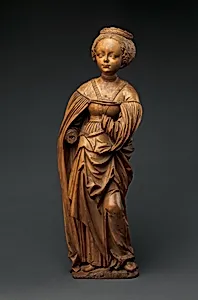
Saint Barbara
Unknown Artist
ca. 1510
Medium
Limewood
Dimensions
Overall: 24 1/8 x 8 13/16 x 5 3/16 in. (61.2 x 22.4 x 13.2 cm)
Classification
Sculpture-Wood
Culture
German
Department
Medieval Art
Museum
Metropolitan Museum of Art, New York, NY
Credit
Bequest of George Blumenthal, 1941
Accession Number
41.190.95
Rights
Public Domain
Tags
Art Historical Context
This exquisite limewood sculpture of *Saint Barbara*, created by an unknown German artist around1510, captures the's serene piety in a compact yet commanding form, measuring 24 1/8 x 8 13/16 x 5 13/16 inches. Housed in the Metropolitan Museum of Art's Medieval Art Department through the bequest of George Blumenthal in 1941, it the enduring tradition of wooden devotional figures in late medieval Germany. Saint Barbara, one of the Fourteen Holy Helpers, is revered as a protector against sudden death and lightning, often invoked by miners and soldiers—professions vital to the region's economy. Carved from limewood, a favored medium in Northern Europe for its fine grain and carvability, the statue likely served in a church altar, private chapel, or processional context. The artist's skillful rendering of drapery folds and poised stance reflects the transition from Gothic expressiveness to emerging Renaissance naturalism, blending spiritual symbolism with lifelike detail. Though unpainted today, such works were originally vividly polychromed, enhancing their role in inspiring faith among worshippers. Today, this poignant artwork invites reflection on women's roles in medieval hagiography and the craftsmanship of anonymous artisans whose devotion shaped German religious art. A testament to faith's quiet power, it bridges the sacred and everyday in early 16th-century Europe.