
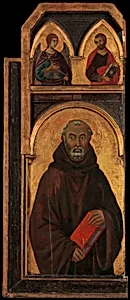
Saint Benedict
Medium
Tempera on wood, gold ground
Dimensions
Overall, with framing elements, 49 x 20 7/8 in. (124.5 x 53 cm); Saint Benedict, painted surface 27 7/8 x 16 in. (70.8 x 40.6 cm); pinnacle, painted surface 10 1/4 x 15 3/8 in. (26 x 39.1 cm)
Classification
Paintings
Department
European Paintings
Museum
Metropolitan Museum of Art, New York, NY
Credit
Harris Brisbane Dick Fund, 1924
Accession Number
24.78c
Rights
Public Domain
Tags
Art Historical Context
In the serene glow of its gold ground, *Saint Benedict* (ca. 1320s) by Segna di Buonaventura the devotional elegance of Sienese Gothic painting.ed in tempera on wood, vertical panel portrays the founder of Western monasticism, founder of the Benedictine order, clad in monastic robes and likely holding his influential *Rule*, a foundational text for medieval religious life. Flanking angels in the pointed pinnacle add a heavenly frame, inviting viewers into a sacred dialogue. Segna, a follower of the masterful Duccio di Buoninsegna, worked in Siena during a golden age of Italian panel painting, where such works adorned altarpieces in churches. The artwork's luminous gold leaf—applied over a bole ground and tooled for texture—creates an otherworldly radiance, symbolizing divine presence and drawing the eye heavenward, a hallmark of 14th-century Tuscan technique. Tempera, made from pigments bound in egg yolk, allowed for vibrant colors and fine details in the saint's expressive face and flowing drapery. At nearly four feet tall including its frame, this piece would have stood as a focal point for worshippers, fostering personal piety amid Siena's thriving religious culture. Today, housed in The Metropolitan Museum of Art's European Paintings department (acquired via the Harris Brisbane Dick Fund in 1924), *Saint Benedict* offers a window into medieval spirituality, where art bridged the earthly and eternal.