
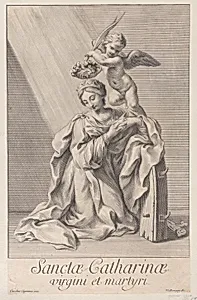
Saint Catherine of Alexandria, kneeling with her elbow resting on the spiked wheel, and an angel crowning her with a flower wreath
Carlo Cignani|Sir Nicolas Dorigny, 1698
About this artwork
In the intricate etching *Saint Catherine of Alexandria, kneeling with her elbow resting on the spiked wheel, and an crowning her with a wreath* (1698), we encounter a poignant depiction of the revered Christian martyr. Saint Catherine, a 4th-century scholar and noblewoman, is famously associated with the breaking wheel—a torture device that miraculously shattered under her, symbolizing divine protection. Here, she kneels gracefully beside the wheel, her elbow resting upon it, while a tender angel crowns her with a wreath, evoking themes of triumph over suffering and heavenly reward. This imagery draws from longstanding hagiographic traditions, blending earthly trial with celestial glory. Created after a design by Italian Baroque master Carlo Cignani (1628–1714), known for his elegant, luminous religious scenes, the print was masterfully etched by Sir Nicolas Dorigny (1658–1746), a French engraver renowned for his reproductive works after Italian artists. Etching, an intaglio technique using acid to bite lines into a metal plate, allowed Dorigny to capture the fluid grace and dramatic chiaroscuro of Cignani's style with remarkable fidelity. Produced in 1698 amid the late Baroque era, it reflects the Catholic Church's emphasis on vivid saintly narratives during the Counter-Reformation. Housed in the Metropolitan Museum of Art's Drawings and Prints department (The Elisha Whittelsey Collection, 1951), this 14 9/16 × 9 3/16 in. sheet exemplifies the era's fusion of painting and printmaking, making grand religious art accessible beyond oil canvases. A testament to technical virtuosity and devotional fervor, it invites visitors to ponder resilience and grace.