
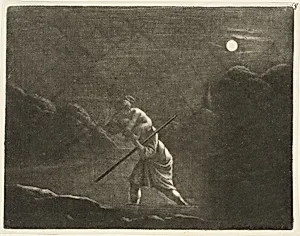
Saint Christopher
1665/77
Medium
Mezzotint in black on ivory laid paper
Dimensions
Image/plate: 16.9 × 21.9 cm (6 11/16 × 8 5/8 in.); Sheet: 17.6 × 22.7 cm (6 15/16 × 8 15/16 in.)
Classification
mezzotint
Department
Prints and Drawings
Museum
Art Institute of Chicago
Accession Number
191342
Rights
Public Domain
About this artwork
In this print, Wallerand Vaillant articulates landscape, figure, and atmosphere with the perfect subtlety of light. Mezzotint was a relatively new intaglio process in which the artist burnished out highlights and gradations, effectively erasing the darkness, from a completely roughened copper plate that would print black if left untouched. In the final state the artist added stars, as well as more definition to the clouds and landscape, and intensified the highlights of the figures and their res...
Art Historical Context
**Saint Christopher** by Wallerand Vaillant, between 1665 and 1677, captures the legendary protector of travelers in a striking mezzotint print.illant, a skilled Dutch engraver of the 17th century depicts the giant saint wading through waters while cradling the Christ Child on his shoulder—a classic iconographic motif symbolizing faith's burdens and divine strength. Housed in the Art Institute of Chicago's and Drawings Department, this work measures a modest 16.9 × 21.9 cm, inviting close contemplation of its intricate details on ivory laid paper. Mezzotint, the innovative technique Vaillant employs here, revolutionized printmaking in the Baroque era. Unlike traditional engraving's sharp lines, mezzotint begins with a roughened copper plate that yields deep, velvety blacks and subtle gradations of tone, mimicking the richness of oil paintings. Invented around the 1650s, it allowed reproductions of dramatic lighting and texture, making religious subjects like Saint Christopher accessible to a wider audience through affordable prints. This piece reflects the era's devotion to saintly intercessors amid Europe's turbulent times, blending spiritual reverence with technical virtuosity. A testament to Vaillant's mastery, it highlights how prints bridged art and piety for 17th-century collectors. (198 words)